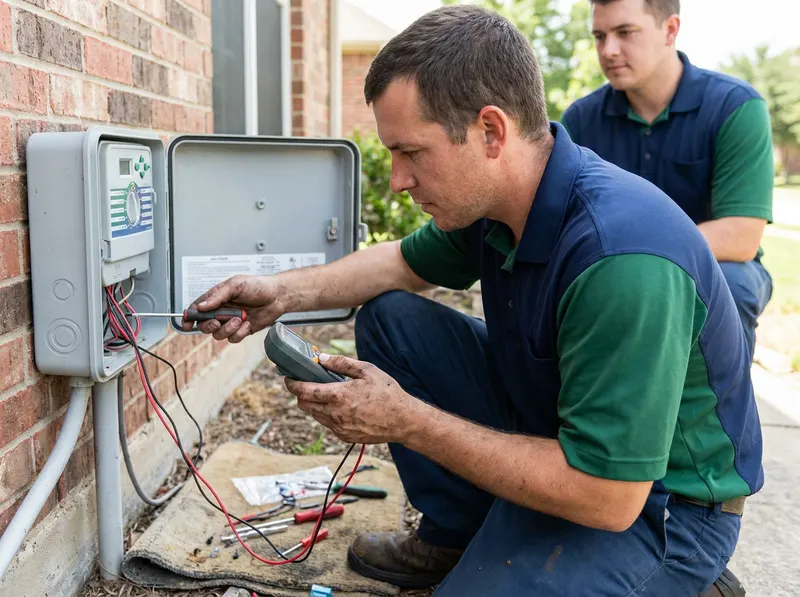
A sprinkler controller repair starts by confirming power at the outlet, then reading the transformer output, which should measure about 24 to 28 volts AC on a healthy unit. Older mechanical and early digital timers…
A sprinkler controller repair starts by confirming power at the outlet, then reading the transformer output, which should measure about 24 to 28 volts AC on a healthy unit. Older mechanical and early digital timers common in Lakewood and the M Streets bungalows often fail at the internal fuse or the backup battery, while newer smart controllers in Preston Hollow and Kessler Park more often lose Wi-Fi settings or throw a station-fault alarm from a shorted valve wire. A blank screen after a summer storm usually points to a surge-damaged transformer; a single dead zone while others run points to a broken field wire or a bad solenoid rather than the controller itself. The WaterSense-labeled irrigation controllers program lists weather-based models that cut runtime automatically, which is why many Casa Linda and White Rock homeowners upgrade an aging clock instead of repairing it.
Deciding between repair and replacement comes down to the fault and the age of the timer. If a 4, 8 station controller has a blown fuse, a loose terminal, or scrambled programming, a repair in the $95, $250 range restores it same visit. If the transformer is fried, the display is cracked, or the unit predates modern surge protection, a replacement in the $200, $550 range is the practical path, a new controller carries better lightning protection, and North Texas storms roll hard off the Trinity River corridor and over White Rock Lake. Upgrading to a weather-based timer suits larger Preston Hollow and Lake Highlands lots where zone counts run 10 stations or more; a straight like-for-like swap suits a smaller Oak Cliff or Bishop Arts District yard with 4, 6 zones. The trade-off is upfront cost against long-term water savings on a Dallas Water Utilities bill during the mandated watering-day limits.
Dallas sits on expansive clay that shifts with the seasons, and that movement stresses buried valve wiring back to the controller, so a station that worked in spring can drop out by August. Vickery Meadow and Casa Linda properties with older splices frequently show corrosion at direct-burial connections, which reads at the controller as a repeating station fault. The diagnostic sequence is simple: 1) verify incoming power and transformer voltage, 2) test each station terminal for a signal, 3) isolate whether a dead zone is wiring, solenoid, or controller, and 4) reprogram start times and durations to match current watering restrictions. The city's Save Dallas Water guidance and the Tarrant Regional Water District both publish seasonal watering schedules that a controller should mirror.
Grounding a controller correctly matters because a floating ground invites the surge damage the Electrical Safety Foundation International warns about, and 24-volt low-voltage work still follows the low-voltage sections of the NFPA 70 National Electrical Code. Efficient scheduling references from the Irrigation Association and drought outlooks from the U.S. Drought Monitor for Dallas County help set realistic run times, and the National Weather Service Fort Worth office tracks the storm patterns that most often knock out a timer. For soil-moisture and native-plant timing, the Texas A&M AgriLife horticulture resources note that clay soils absorb slowly, favoring shorter, repeated cycles a properly programmed controller can deliver.
Every job gets a firm, written price after a free on-site visit.
Tell us about your sprinkler controller repair job in Dallas and we'll send a clear, written quote, usually the same day.
 Dallas Green Sprinkler Repair